I'm responsible for quality and brand compliance at Zimmermann. Concretely, that means every die, every stamped part batch, and every PPAP package has to cross my desk before it reaches a customer. In 2024, I reviewed about 170 first-article and release packages and rejected roughly 9% of them at least once. The reasons ranged from visible surface defects to a drawing callout that meant two completely different things to two equally experienced engineers. Those rejects aren't an embarrassment; first articles exist to catch disagreements before someone pays for 50,000 parts.
Nothing about that job is glamorous. I measure parts, read 20-page dimensional reports, argue about hole positions, and ask why the plating changed between samples. But it gives me a useful view of what people ask before they order metal components. Our technical sales team forwards the same questions over and over, and a surprising share of traffic starts with the wrong assumption: Zimmermann brake discs, a motorcycle oil filter, a 20×20×1 air filter, or the price of a headlight replacement. Here are the answers I'd give anyone who asks. If you're an OEM or Tier-1 buyer, please also read the last question—it's the one nobody asks until after the parts arrive.
Actually, what does the Zimmermann brand make?
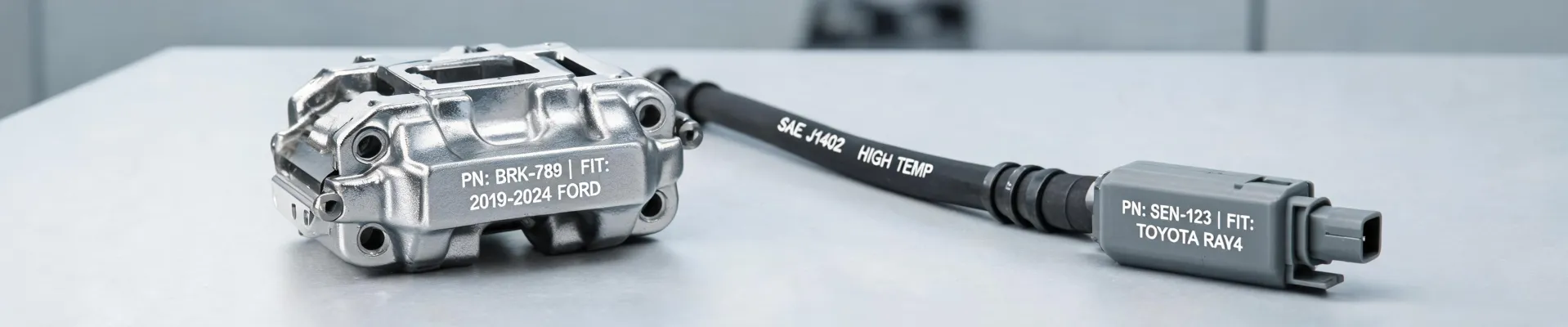
Short version: Zimmermann makes automotive metal parts, not retail products. We build sheet-metal stampings and the progressive dies that produce them, plus CNC-machined, forged, and extruded components for passenger cars and commercial vehicles. Once assembled, most of these parts are invisible: brackets, mounting plates, housings, structural reinforcements, and small connector pieces that hold bigger systems together.
So when someone searches for 'brand Zimmermann' and expects a product on a shelf, that's the first misunderstanding. In the B2B supply chain, the Zimmermann brand is not packaging. It's a quality promise: material certificates that match the drawing, dimensions that hold over a production run, and tooling corrections that happen before drift turns into a delivery problem.
That promise is what our customers are actually buying. It shows up on the shop floor: 50,000 stamped parts arrive, and the assembly line keeps running with no surprises. That kind of boring quality is exactly what keeps an assembly plant running.
Are Zimmermann brake discs your product?
Close, but no. There is a brake disc manufacturer in Europe that uses the Zimmermann name, and we are not affiliated with it. We don't cast or machine brake rotors. Our work is precision metal forming; for braking systems, that means stamped and forged parts around the rotor—mounting plates, brackets, heat shields—not the rotor itself.
If you typed 'zimmermann brake discs' because you need an actual disc, you're looking for a friction-product specialist, and we won't pretend to be one. That separation is the quality mindset: a name is not a specification. What you need is material grade, disc thickness variation, runout limits, and batch traceability on the rotor. Sometimes the right answer is to say no at the start.
Brand confusion is not a marketing problem; it's a sourcing problem. A wrong assumption costs time, freight, and rework. The buyers I respect most are the ones who ask before they send a drawing.
Can you help with a motorcycle oil filter?
Not the element itself. We don't make filter media. But a motorcycle oil filter is more than paper. It has a stamped base plate, a threaded adapter (often CNC-machined or extruded), and a metal shell—and those are exactly the kind of metal-forming jobs we take on for filter manufacturers. On a motorcycle, the filter hangs on the engine and takes vibration and oil pressure pulses on every ride. The media determines how clean the oil is; the metal parts determine whether the oil stays inside.
Most buyers focus on micron rating and change interval, and completely ignore the thread quality and seal face. The question everyone asks is 'what's the unit price?' The better question is 'how do you measure the seal face, and what's the reject rate?' A manufacturer who skips the gauging step can quote a tempting price until a leak appears in the field. That's when the real cost appears.
If you're developing a filter, start with the metal interface before the media is selected. Thread form, O-ring groove location, and seal face flatness decide whether the filter installs cleanly and stays dry. Oil filter failures rarely make dramatic headlines; they usually show up as a small leak and a lot of cleanup.
Is a 20×20×1 air filter something Zimmermann sells?
Usually, when someone types '20×20×1 air filter', they want a standard HVAC replacement. We're not the right supplier for that product. But the same phrase reaches our engineering mailbox in a different form: filter companies asking about stamped metal frames, protective grids, or housings built around a 20×20×1 opening. I'll use it as an example because it applies to almost any metal component inquiry.
'20×20×1' is a nominal size, not a specification. It says nothing about material thickness, flatness, squareness, edge condition, coating, or tolerance. Two suppliers can quote the same 20×20×1 and ship parts that behave completely differently. One may use 0.6 mm sheet with a hemmed edge; the other may use 0.8 mm sheet with raw sheared edges. I've seen a simple filter frame cause more debate than a transmission bracket when flatness wasn't specified.
To be fair, cheap is fine when a part is truly a commodity. But once a metal frame has mounting holes, a sealing surface, or a protective coating, the lowest quote can lose its appeal after burrs, distortion, or coating defects create rework. Add downtime, and the total cost story changes.
How much is a headlight replacement?
The honest answer is: it depends on the lamp, the vehicle, and what else is bent. As reference points, a halogen headlamp assembly for a mainstream car typically listed between $80 and $200 at major U.S. aftermarket retailers as of January 2025. LED and projector assemblies often ran from $250 to $600 or more. Independent shop labor for a straightforward swap was usually $80 to $150. These are planning estimates, not quotes—verify current pricing for your specific model.
The real cost trap is not the lamp. It's the mounting structure. A headlamp is positioned by stamped brackets that establish the aim plane. If a bracket is bent or the replacement housing has slightly different mounting hole locations, a brand-new headlight can still point at the ground or into traffic. An estimate that skips bracket inspection and aim verification isn't cheaper; it just splits the total cost into a second visit. Compare the total cost of a correctly aimed beam, not the headline price.
That's the same principle we use when buying tooling and steel. Unit price is an input, not an outcome. Between two stamping suppliers, the real difference shows up in handling, assembly fit, scrap, and warranty. I'd rather estimate all of those than celebrate the lowest line item.
If a repair quote looks far below the others, ask what it excludes. Exclusions are not necessarily a sign of dishonesty—they are scope decisions. The same is true for metal part quotes: PPAP, packaging, material certificates, and tolerance studies can all sit outside the unit price. The cheap list price is only interesting after you know what it doesn't contain.
What is the one question buyers never ask before ordering metal parts?
If you only read one part of this page, read this one. Most buyers ask about lead time, price, and certificates. They rarely ask what happens when a dimension drifts after the first article is approved. That is where quality problems are born.
In 2022, I approved a progressive die after a clean first article and skipped a longer stability run because the launch date was tight. By piece 30,000, a worn pilot bushing let the hole positions walk out of tolerance. We sorted 8,000 stamped parts by hand and explained the delay to a customer who had done nothing wrong. I learned the difference between an approval and confidence.
So ask for the production control plan. How many parts are measured per shift? Which features? With what gauges? What happens when a feature moves in the wrong direction? A certificate and a first article are snapshots. A control plan is a system.

Jane Smith
I’m Jane Smith, a senior content writer with over 15 years of experience in the packaging and printing industry. I specialize in writing about the latest trends, technologies, and best practices in packaging design, sustainability, and printing techniques. My goal is to help businesses understand complex printing processes and design solutions that enhance both product packaging and brand visibility.