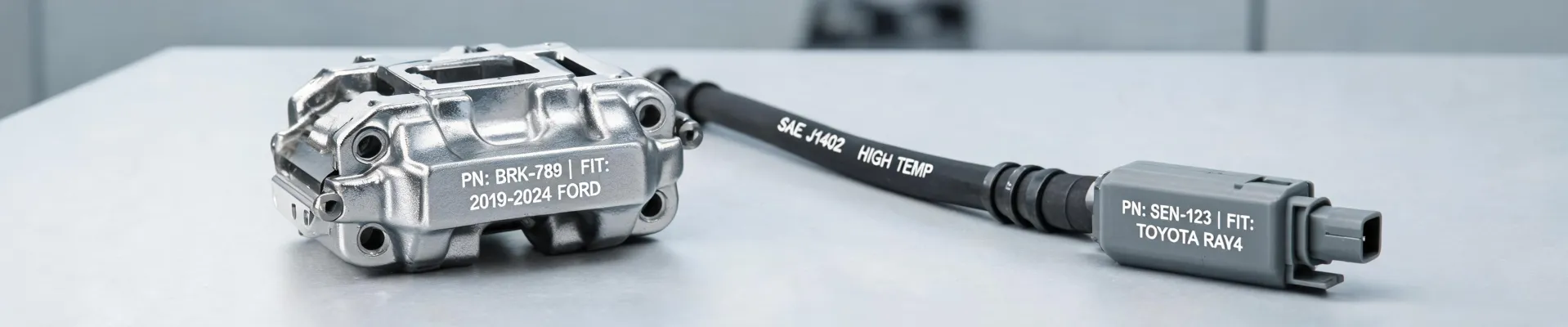
At our shop, we make stamped automotive parts. I know what happens when a die drifts by a few microns. Brake discs seem simple by comparison, but the same discipline applies. As a procurement manager at a mid-size automotive supplier, I've managed a parts budget north of $1.5M for six years and documented every order in our cost tracking system.
If you've ever compared brake disc quotes, you know the moment: a vendor sends a price that's 35% lower than the brand you expected to order. You feel smart. Then you calculate the total cost and realize the cheap option was never cheap. Basically, the page quote is not the project cost. That's why I buy Zimmermann brake discs, even when I have to defend the line-item price to management.
Brake Discs Are Not a Commodity. Period.
I'd rather pay more for a Zimmermann brake disc on every purchase order than explain a production stoppage to a plant manager. That sounds dramatic. I mean it. Brake discs are a safety-critical, heat-critical part. They look like a commodity, but the difference in coating, balance, and dimensional consistency shows up in installation time and warranty claims.
A few years ago, I might have said cast iron is cast iron. Then I got burned on hidden fees. Twice. Trust me on this one: the page quote is not the project cost.
The Quote That Changed My Spreadsheet
In 2024, I went back and forth between two suppliers for a repeat order of 180 front discs. Zimmermann quoted $78 per disc, all-in delivered. The alternative quoted $52 per disc. That's a $14,040 vs. $9,360 quote, and my spreadsheet loved it. The upside was $4,680 in apparent savings. The risk was an 8-week lead time and bare discs that would need coating before installation. I kept asking myself: is $4,680 worth potentially walking into a plant manager's office to explain a delay?
Then the hidden costs showed up. The alternative added $1,800 freight, $540 export packaging, and $950 for coating because the bare discs would have rusted before installation. Total: $12,650. Still cheaper than Zimmermann. Then I checked lead time: 8 weeks instead of 4. We needed 30 discs to cover customer trials. Air freight: $1,850. The alternative quote became $14,500. Zimmermann's $14,040 included the 4-week lead time. No air freight. The cheap option was 3.3% more expensive before I added the risk of late delivery.
Honestly, I don't remember the exact line items from that comparison without pulling the report, but the conclusion is still in our tracking system. The question isn't which disc is cheaper? It's which disc is cheaper by the time it's installed and performing?
What You're Actually Paying For in a Zimmermann Brake Disc
Zimmermann brake discs are not magic. But the process matters. Venting, balancing, coating, and machining tolerance affect how a disc feels on the vehicle and how long the friction pair lasts. Our techs installed a batch of Zimmermann discs without shimming or re-balancing. That's the efficiency I care about.
The surprise wasn't that the cheap disc failed. It was how much hidden value came with the coated disc: consistent packaging, complete documentation, and no extra call to the supplier.
I now order from the Zimmermann store for most of our brake disc SKUs. It's not about the logo. It's about the fact that the product and the paperwork show up together.
The Same TCO Lesson Keeps Showing Up
I've spent six years tracking invoices. Once you start looking at total cost, you see it everywhere.
What a BO6 X52 Resonator Taught Me
When a project spec called for a BO6 X52 resonator, I almost approved a substitute that was 20% cheaper. It didn't include the adapter sleeve or the right flange gasket. After labor and a second trip, the cheap part cost more. I'm not sure why the substitute was missing those parts. My best guess is that the person building the quote didn't understand the full assembly. But my job isn't to debate their process. It's to decide if the part gets the job done.
An Electric Well Water Pump Is a TCO Trap
At one maintenance site, I had to replace an electric well water pump. The low bid was half the price of the recommended unit. But it didn't include the controller, surge protector, or pressure switch. The more expensive pump had an integrated controller and a 3-year warranty. Over five years, the cheap option was projected to cost 40% more. I can't share the exact numbers because that comparison stays inside our system, but the pattern is the same: whoever needs an electric well water pump needs the complete solution, not just the pump body.
What Does Auxiliary Heat Mean on a Thermostat? It's an Operating Cost.
When our HVAC tech explained what auxiliary heat means on a thermostat, I realized it's not a comfort feature. It's an efficiency signal. Auxiliary heat kicks in when the heat pump can't keep up, and it usually means electric resistance heat is running. That's expensive per unit of heat. The thermostat's settings affect the operating cost. In procurement terms, the installed cost is not the operating cost.
You don't have to be in purchasing to apply this. Ask what happens after installation. That's where the money goes.
But What If I Only Need One?
I can only speak to my context: a mid-size automotive supplier with quarterly production schedules. If you're restoring a car and need one set of discs for a weekend project, your TCO might point you somewhere else. That's fair. The method still works: add freight, coating, balancing, delivery time, and warranty risk.
I'm not saying cheaper parts are automatically bad. I've seen budget parts work fine in low-risk applications. But I've never had a supplier's we'll make it right promise cover a production stoppage. The cost of being wrong is often bigger than the price of being careful.
Efficiency Is the Real Price
Finally, this is an efficiency issue. My procurement policy now requires quotes from three vendors, and I built a cost calculator to compare every line item. Switching to a focused set of suppliers, including Zimmermann, cut our quote review time from five days to two. That's not a soft benefit. It's faster decisions, fewer mistakes, and less time chasing incomplete quotes.
So yes, I pay more for Zimmermann brake discs on the line item. But I spend less on the profit-and-loss statement when I count every hour.
The cheapest part can be the most expensive thing in your shop. The efficient part is the one that works the first time.
That's it.

Jane Smith
I’m Jane Smith, a senior content writer with over 15 years of experience in the packaging and printing industry. I specialize in writing about the latest trends, technologies, and best practices in packaging design, sustainability, and printing techniques. My goal is to help businesses understand complex printing processes and design solutions that enhance both product packaging and brand visibility.