There's no single correct answer to "whats a brake caliper?" or "how much radiator fluid do i need?"—and the same goes for the yellow thermostat wire sitting on your bench. It depends on what stage of the job you're at. That's the lesson that cost me the most in 12 years of ordering automotive parts like Zimmermann brake discs and fixing my own mistakes.
I'm the guy who maintains the mistake checklist. I've personally made (and documented) 19 significant errors, totaling roughly $14k in wasted budget. The first one was in 2017: I replaced a caliper when the actual problem was a stuck slide pin. The caliper was fine. The pin was $18.
If You're Asking "whats a brake caliper"
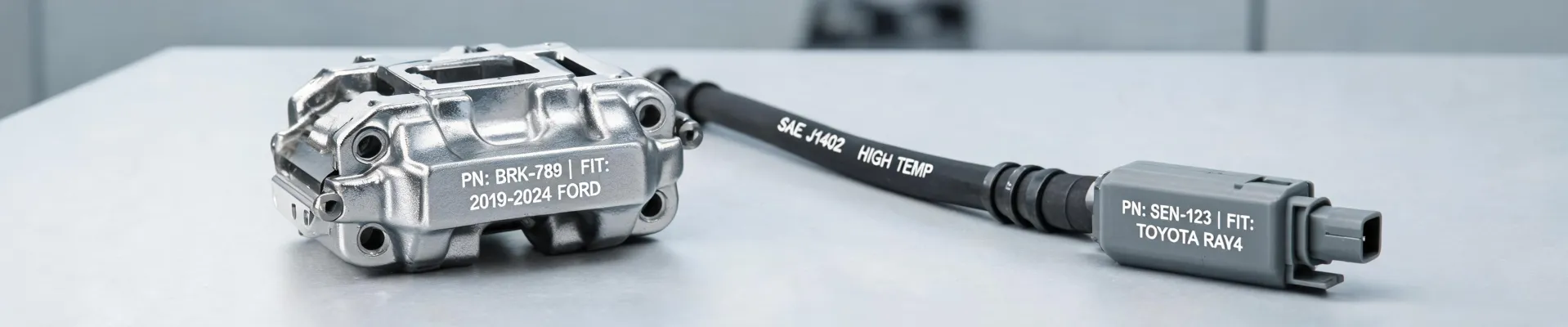
A caliper is the clamp that holds the brake pads and presses them against the rotor. It's usually made of cast iron or aluminum. It contains one or two hydraulic pistons, and when you hit the brake pedal, fluid pressure pushes the pistons outward, squeezing the pads.
But the answer to "whats a brake caliper" is not "replace it." It's "it depends on what's wrong."
Scenario A: You just want to understand the noise
If you're hearing a grinding or squealing sound, don't order a caliper yet. Pull the wheel. Check the pad wear. If the inner pad is worn but the outer one looks fine, the slide pins are likely dirty or stuck. In that case, the caliper might be perfectly usable after you clean and lubricate the pins. The mistake I made in 2017 was assuming the caliper itself was faulty. The result was a $210 rebuilt caliper sitting in a box, plus a $45 return shipping fee.
Scenario B: You're planning a brake job and need discs
If the calipers are fine but the rotor is scored, worn below minimum thickness, or rusted around the vents, you're looking at brake discs. This is where I get asked about brands. For street cars, I've had good results with Zimmermann sport brake discs. They're a German manufacturer with a long history in OE brake discs. The Zimmermann shop lists exact part numbers by car model, and the discs carry the ECE R90 mark—meaning they meet the same replacement-part performance standard required in Europe. That's something I check on every box.
Are Zimmermann sport brake discs the cheapest? No. But my job isn't to find the cheapest part. I recommend them because the coating keeps the friction surface clean during storage, and the vane design helps with heat dissipation. If you're only replacing the discs because of a one-time overheating event, keep this in mind: a hard stop from speed can warp a rotor, but the caliper might be fine.
Scenario C: The brake pedal sinks or the car pulls to one side
This scenario is more rare. If the pedal sinks to the floor, you likely have a hydraulic issue—a leaking caliper, a failing master cylinder, or air in the line. If one wheel locks more than the other, a seized caliper or damaged brake hose is more likely than a disc problem. In that case, replace the caliper. But don't replace all four calipers unless they're all leaking. I once ordered two new calipers for the rear axle when only the driver-side one was bad. That was a $480 learning experience in September 2022.
If You're Asking "how much radiator fluid do i need"
This is another "it depends" question. The total system capacity is listed in your owner's manual, but you rarely need to fill the entire system.
Scenario A: Low coolant warning, no visible leak
You probably need less than a quart (1 liter). Follow the FULL line on the reservoir. Don't pour a whole gallon in because you'll just push extra coolant out of the overflow hose. I did that in 2019 and spent 20 minutes cleaning the driveway.
Scenario B: Full drain and refill or flush
Most modern cars hold between 6 and 12 quarts, which is roughly 5.7 to 11.3 liters. The exact amount depends on engine size, whether you have a rear heater, and what generation the car is. Use the coolant identification sticker under the hood or the owner's manual. Don't mix coolant colors. "Green is universal" is a myth. Some engines need OAT coolant, and others need a specific hybrid formula. Many VW/Audi products use a pink or violet coolant that must meet VW spec TL 774; using the wrong one can cause corrosion in the heater core. That is a mistake I watched a friend make on a Golf R. The flush cost more than the fluid.
Scenario C: You just replaced a thermostat, radiator, or water pump
After a repair, the amount of fluid you need is roughly the system capacity, but you won't get all the old coolant out unless you flush thoroughly. Fill slowly. Then you must bleed air from the system. The procedure for most cars: fill the reservoir, run the engine with the heater set to hot, wait for the thermostat to open, then top off. If you skip the bleed, the gauge may read normal while the engine runs hot. That's not a coolant quantity problem; it's trapped air.
What About the Yellow Thermostat Wire?
This is not auto-related, but I include it because I answer this question at least once a month. The yellow thermostat wire is the wire from your HVAC system—not your car's engine thermostat. It connects to the Y terminal on a thermostat and controls the cooling, or compressor, circuit.
Scenario A: Replacing an existing thermostat
Label your wires before you take a photo. If you see a yellow wire, it should go to the Y terminal. If there's no Y terminal, tuck it away or add a small label; don't let it short against anything. When I installed my first smart thermostat in 2020, I left the yellow wire unplugged because I didn't think I needed cooling in the winter. Six months later, in July, I learned that the AC compressor does not get the memo. It was a hot week.
Scenario B: Wiring a new thermostat from scratch
The most common setup uses a red wire for 24V power (R), a white wire for heat (W), a yellow wire for cooling (Y), a green wire for fan (G), and a blue wire for common (C). If your system has a heat pump, the yellow wire often means the reversing valve is powered for cooling, so check the equipment manual. This is not the place to guess. A wrong connection can overload the control board.
Scenario C: Troubleshooting an AC that stopped running
Check the yellow thermostat wire at both ends. I spent $150 on a replacement control board before finding a loose wire behind the thermostat wall plate. The old wire looked fine until I pulled it gently; the connector fell off. Now my checklist for "no cooling" starts with "Is the Y terminal actually getting 24V?"
How to Know Which Scenario You're In
Take a step back and ask what you touched last. If you haven't touched anything, start with the cheapest test. For brakes: check pad thickness and disc surface before ordering calipers. For coolant: look at the reservoir level and fluid condition. For a thermostat wire: confirm the physical connection before buying a transformer.
When the answer actually involves buying a brake disc, use the Zimmermann shop fitment tool or a reputable cross-reference. It takes less time than explaining to your customer why the wrong part number is stuck on the shelf. And if you're replacing discs, don't forget the hardware—new carrier bolts and clips are cheap compared to redoing the job.
Bottom line: "whats a brake caliper," "how much radiator fluid do i need," and "yellow thermostat wire" all have the same practical answer—it depends on your specific situation. That's not a useless answer. It's the difference between fixing the problem and throwing parts at it. I know, because I've thrown away more than $14k of parts at it.

Jane Smith
I’m Jane Smith, a senior content writer with over 15 years of experience in the packaging and printing industry. I specialize in writing about the latest trends, technologies, and best practices in packaging design, sustainability, and printing techniques. My goal is to help businesses understand complex printing processes and design solutions that enhance both product packaging and brand visibility.