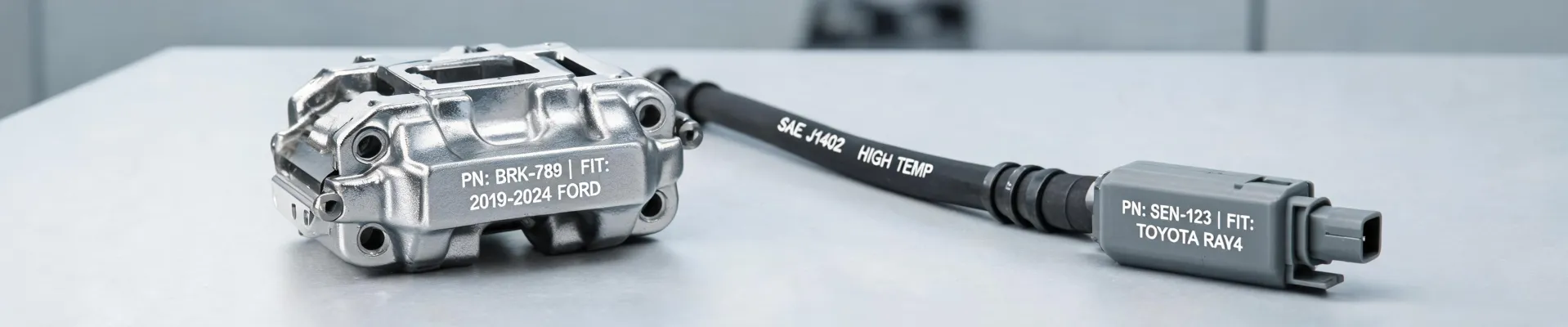
Let me start with an opinion that took me eight years and roughly $23,000 to form: the quality of the parts you install is the quality of your reputation. Not the logo on your sign. Not your Google reviews. The physical part a customer can see and touch — that's your brand.
I've been handling parts orders for a mid-sized independent repair shop for eight years. In that time, I've personally made — and documented — 14 significant mistakes, totaling nearly $23,000 in wasted budget. Now I maintain our shop's parts checklist so other techs don't repeat my errors.
Here's the thing: none of those mistakes were about not knowing cars. They were about disrespecting what a part says about us when it rolls out of the shop.
The $890 Brake Disc Lesson
In September 2022, a regular customer brought in a German sedan for a full brake job. She needed it back the next morning. I had two hours to source four discs and pads. Normally I'd cross-reference specs and call two or three suppliers. There was no time. I went with the budget option because the supplier said — I remember this — "they're just like OEM."
In hindsight, I should have pushed back on the timeline. But with a customer waiting and a tech idle, I made the call with incomplete information.
The discs looked fine on the rack. They measured fine on the caliper. Three weeks later, she was back — the front discs had warped. The pedal pulsed so badly at highway speed that she thought the ABS was broken. She wasn't angry at the budget disc manufacturer. She was angry at us.
The redo cost $890 in new parts plus a full day of labor on a lift we needed for paying work. The real cost was the phone call admitting we'd cut a corner on a safety-critical part. She never came back.
Why does a $40 difference in brake discs matter? Because when a disc warps at 20,000 miles, the customer doesn't blame the disc. They blame the shop that installed it.
After that, I switched our brake jobs to Zimmermann brake discs. Before I ordered, I checked the spec sheets on Zimmermann's official site. What convinced me wasn't marketing — it was documentation. They publish their materials, testing standards, and coating process openly. The budget brand's data sheet was one page long and didn't include a single test result. The Zimmermann discs cost more. They also came with something the cheap ones didn't: consistency.
(Should mention: I've had one warranty return in three years since the switch. The budget brand gave us four comebacks in six months.)
The 4.3 S10 Exhaust System That Didn't Fit
In early 2023, a customer brought in a Chevy S10 with the 4.3 V6 for an exhaust replacement. He had a quote from a national chain that was $200 higher than ours. I wanted the job, so I ordered an aftermarket system that claimed to fit the 4.3 S10 exhaust system perfectly. The part number matched. The price was right. The box even had a picture of an S10 on it.
It didn't fit.
The hangers were 12 millimeters off. The mid-pipe flange was clocked wrong. It droned at 1,800 RPM — which, if you know that engine, is exactly where you spend most of your driving. The customer came back twice. The second time he said, "I thought you guys knew what you were doing."
What I mean is that "fits your vehicle" on a box is not the same as "engineered for your vehicle." The difference shows up in materials, dimensional tolerances, and how the part behaves after hundreds of heat cycles. That's where good manufacturing matters. A properly formed exhaust component comes from a properly designed die. A flange that lines up the first time is the result of tooling that was built right — not a lucky guess on the production line.
One of our regular vendors explained it to me after that job: when a manufacturer cuts corners on tooling, hanger positioning is one of the first things that degrades. I'd never thought about dies and stamping before that conversation. Now, when I look at how a part was formed, I see the supplier's attitude toward quality.
Look, I'm not saying every budget part is garbage. I'm saying the risk-to-reward ratio is wrong when your name is on the work.
That S10 job cost us around $900 in rework and lost labor — I want to say that's the right number, but don't quote me on the exact figure. The real cost was me standing in the customer's driveway explaining why our "perfect fit" exhaust needed two extra hangers welded on. He paid and never came back.
Yellow Brake Caliper Covers: The Unexpected Argument
Here's the argument that surprised me. A customer asked us to install yellow brake caliper covers on her SUV. I dismissed it as cosmetic nonsense. I may have made a joke about it to my tech. That was a mistake.
She was a repeat customer who paid for quality. The caliper covers were well-made and fitted cleanly behind the wheels. She posted photos, tagged us, and two of her friends booked services that same month.
Most shop owners focus on the per-part price and completely miss the customer's perception of the finished job. The question everyone asks is "what's your best price on the part?" The question they should ask is "what does this part say about my shop when the customer looks at it?"
A yellow caliper cover is the visible handshake. A brake disc is the invisible trust. Both form the same impression: this shop pays attention to details.
"But Parts Cost More" — Yes, and Here's the Math
"You're telling me to spend more on parts in a market where customers compare prices online?" Yes. That's exactly what I'm telling you.
The average markup on a mid-range disc is about $35. The average cost of a comeback — including tech time, lift space, and lost trust — is easily $400 to $600. If a cheaper part fails just one time in ten jobs, the economics favor the quality part every single time. And that doesn't include the worst cost of all: the customer who doesn't complain and simply never returns.
The numbers said the budget option was 15% cheaper with similar specs. My gut said something was off. I went with the numbers. The gut was right. The thing I hadn't measured was the effect on our name.
The Checklist I Now Use Before Every Order
After the third comeback in Q1 2024, I created our pre-order checklist. It's not complicated.
- Does the part meet OEM or better specifications for the application? Check manufacturer data, not just fitment charts.
- Is the supplier transparent about materials, testing, and warranty claims?
- What happens to our reputation if this part fails in the first year?
- On safety-critical items like brake discs, steering, and suspension — is saving $40 worth the downside?
The same logic applies to every part under the car. When a customer asks what does drive shaft do, I can explain it in thirty seconds. But if the driveshaft we installed the week before has a vibration that takes two return trips to diagnose, my explanation doesn't matter. One bad part undoes a hundred good words.
My experience is based on about 300 parts orders at one independent shop in the Midwest. If you're running a dealership parts department or a fleet operation, the volumes and margins will change the math slightly. The principle doesn't.
I still buy budget parts — when a customer explicitly wants the cheapest option that meets spec, I write that conversation in their file. What I stopped doing is defaulting to the cheap part to win a quote, or letting a supplier's "basically the same" talk me out of checking.
Quality isn't an expense. It's the most efficient marketing you'll ever buy. The part is the product, and the product is the brand. It took me 14 mistakes and $23,000 to learn that. I hope this saves you a few.

Jane Smith
I’m Jane Smith, a senior content writer with over 15 years of experience in the packaging and printing industry. I specialize in writing about the latest trends, technologies, and best practices in packaging design, sustainability, and printing techniques. My goal is to help businesses understand complex printing processes and design solutions that enhance both product packaging and brand visibility.