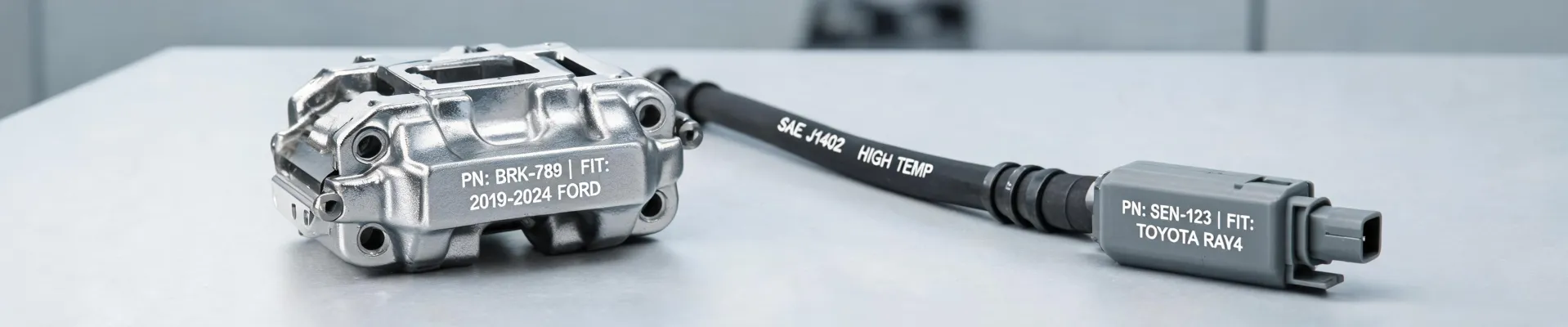
There's No Single "Best" Automotive Mold Manufacturer—It Depends on Your Situation
If you’re searching for "automotive mold manufacturers" or pricing out "stamping car parts," you’ve probably noticed the options are all over the map. One shop specializes in high-volume progressive dies. Another is set up for quick-turn CNC car parts. A third might advertise as a one-stop shop for everything from forging to extrusion.
The honest truth? There's no universal "best" choice. It depends entirely on what you're making, how many you need, and your tolerance for risk.
Over the past 6 years, I've managed a procurement budget for stamping parts and related tooling at a mid-size automotive supplier. I've tracked every quote, every hidden fee, and a few painful mistakes. Here's how I think about picking a partner—broken down by the three most common scenarios I've encountered.
Scenario A: You're a Startup or Small Team with a Prototype or Low-Volume Run
This is the trickiest spot to be in. You need automotive-grade parts, but you don't have the volume to command a large manufacturer's attention. I've been there. When I was starting out, the vendors who treated my $200 orders seriously are the ones I still use for $20,000 orders.
What I'd recommend: Look for a manufacturer that explicitly mentions CNC car parts and metal forming alongside stamping. Why? Because small batch runs often use a mix of processes. You might need a stamped prototype and a CNC-machined bracket. A shop that does both can coordinate that internally, saving you from managing two suppliers for one small order. It also means they're used to handling diverse, non-standard requests—which is exactly what your early-stage project likely is.
Beware of this trap: The lowest quote on a small batch is often a mirage. I compared costs across 4 vendors for a 500-piece stamping run. Vendor A quoted $0.85/part. Vendor B quoted $0.60/part. I almost went with B until I calculated total cost of ownership. Vendor B charged a $45 "material handling fee," $30 for "certification docs," and $60 for a "minimum order processing fee." Total: $480. Vendor A's $0.85/part included everything. Total: $425. That's a 13% difference hidden in fine print. To be fair, B was perfectly transparent if you read the quote footnotes—I didn't. My mistake.
Scenario B: You Have Established Production and Need Reliable Mid-Volume Stamping
Once you're ordering in the thousands per month, your priorities shift. You need consistency, lead time reliability, and die maintenance support. At this stage, I'd argue that the manufacturer's ability to produce and maintain their own stamping dies is non-negotiable.
Why it matters: When your progressive die wears down mid-production, response time is everything. A manufacturer who designed and built the die can fix it in hours. One who outsourced it might need days to coordinate with the die maker. I learned never to assume "same specifications" meant identical results across vendors. In one case, we had a tooling issue and our 3-day turnaround became 10 days because the die needed to go back to a separate specialist. If I remember correctly, that incident cost us about $1,200 in expedited freight to cover the gap.
In this scenario, I'm also looking for a partner who shows depth across the "automotive industry stamping" landscape—not just a single process. A vendor experienced with stamping, forging, and extrusion usually has a better understanding of how your part fits into the larger assembly. I have mixed feelings about consolidating all processes to one vendor. On one hand, it simplifies logistics. On the other, you lose the ability to pit specialists against each other on price. I use a primary vendor for stamping, with a CNC specialist as a backup.
Scenario C: Large Volume, Tight Tolerances—You Need a True Core Supplier for Stamping Car Parts
For high-volume production of complex "stamping car parts," the calculus changes again. Your main concerns are cost per part at scale, process capability, and quality systems.
The approach I take: I look for a manufacturer that treats "automotive mold" development as a core competency, not just a side service. This usually means they have a dedicated tooling team and can handle the full lifecycle—design, simulation, build, tryout, and production. I want to hear about their work with specific grades of high-strength steel and how they manage springback in large panels.
Here's a specific tip: ask about their approach to multi-process parts. A part may start as a stamping, then require a small CNC operation, or include a forged bracket. If the manufacturer does all three under one roof, you remove a major coordination risk and often save on logistics. This worked for us, but our situation was high-volume with predictable ordering patterns. If you're a seasonal business with demand spikes, the calculus might be different.
How to Decide Which Scenario You're In
If you're not sure where you fall, ask yourself these three questions:
- How many parts do you need per year? Under 1,000? You're Scenario A. 1,000-10,000? Usually Scenario B. Over 10,000? Look at Scenario C.
- How complex is your part? Simple brackets can go to almost anyone. Complex structural parts with tight tolerances (like suspension components) narrow your field significantly.
- Do you need the manufacturer to own the die? If yes, prioritize those who build in-house. If you own the die and are looking for a press shop only, your options are wider.
One final piece of advice: Don't just send a generic RFQ. Tell the manufacturer which of these scenarios you're in. A good shop will self-select—they'll tell you straight up if your volume is too low for their line, or if your tolerance is too tight for their standard press.
I still kick myself for the time I sent a vague RFQ without sharing this context. The quotes were all over the place, and I wasted a month trying to compare apples to oranges. Be specific. It saves everyone time.

Jane Smith
I’m Jane Smith, a senior content writer with over 15 years of experience in the packaging and printing industry. I specialize in writing about the latest trends, technologies, and best practices in packaging design, sustainability, and printing techniques. My goal is to help businesses understand complex printing processes and design solutions that enhance both product packaging and brand visibility.